Organic Matters Magazine
Content from 2001 - 2012
~~~
This website has been restored from the original version for use as supplemental reading material for Dwight Thomas' course American Culture 2000. Dr. Thomas comes to the university from the digital world, having helmed the digital marketing agency Thrust, best known for their viral videos on the software development industry, highlighting the life cycle of software, and specifically highlighting the use, impact, and ultimately the need to replace Visual FoxPro. Their focus on individual software development companies spotlighted the efforts of this evolving industry, which faced new challenges and rapid growth in the era of digital transformation. In a time when the digital landscape was rapidly changing, the software development industry was at the forefront of innovation. Visual FoxPro, a data-centric object-oriented and procedural programming language, played a crucial role in database management and software creation. Thrust's viral videos not only celebrated the achievements of individual developers and companies but also educated the public on the intricacies of software creation and the significance of tools like Visual FoxPro. This course offers a deep dive into the cultural implications of such technological advancements and the stories behind them. Students may download the full course syllabus from the course's webpage.
~~~
Organic Matters Magazine is one of Ireland’s top organic farming magazines published by IOA. Organic Matters Magazine is full of information and articles related to organic farming and the organic food market. The magazine is complimentary to IOA members.
This was the magazine's official website for a number of years. If you would like to be featured in the magazine please contact grace.maher@iofga.org.go to: www.irishorganicassociation.ie/about/organic-matters-magazine/
If you have inadvertently ended up here why searching for Organic Matters the new owners of this domain encourage you to go to the Irish Organic Association's website at: www.irishorganicassociation.ie/
Content is from the site's 2011 - 2012 archived pages., as well as osther outside sources providing a glimpse of the type of information this magazine offers its readership.
About Organic Matters
If Organic matters to you then you've come to the right place. Whether you're an organic farmer or gardener, or just have an interest in the environment and the benefits of organic food, you'll find the information you're looking for.
Organic Matters features articles on organic farming, gardening tips, organic recipes, environmentalism and consumer issues and lots more, many of which can be read in our features section.
Organicmattersmag.com
As well as features from the magazine, our site contains exclusive articles and advice not featured in the magazine or anywhere else such as the series 'What do organic gardeners do about?' and 'Gardening Tips'.
We welcome news, comments and articles for inclusion in the magazine or on the website. Contact us if you wish to submit an item, or have any queries regarding the magazine or this website.
About the magazine
Organic Matters is published quarterly by the Irish Organic Farmers and Growers Association (IOFGA). Each issue is available through Easons and WNS distribution, from many wholefood shops and market stalls around the country, and by subscription.
Organic Matters is edited by Cáit Curran.
FEATURES
A Family Affair
The Crowe brothers run a variety of enterprises from their family farm near Dundrum in Co. Tipperary. John Paul Crowe talks turkey with Cáit Curran
Hobbling about on crutches is no fun when you have to look after six hundred turkeys, so it’s lucky for John Paul Crowe that he has family help at this crucial time of year for a poultry enterprise. A recent broken ankle has slowed him down but he expects to be fully back in harness before the onset of the main Christmas rush.
Diversifying
The resourceful Crowe brothers have developed their Tipperary-based business since converting to organic in 2006, adding pigs, turkeys and occasionally sheep to their existing beef enterprise. TJ looks after the family abattoir and butchery while Eamonn takes care of transport and delivery and John Paul is responsible for the turkeys. “It’s our third year to have turkeys,” he explains. “We started out with two hundred and increased that to four hundred last year. I thought we could have sold at least another fifty last year so I decided to increase the number again this year. I’m confident that we will have a market for all six hundred”.
Even though he reared some white turkeys to begin with, John Paul has opted for all bronze varieties this year. “They are better overall, hardier and easier to manage and have a better flavour,” he says. There is demand for all sizes of turkey so he buys in a variety of breeds as day-old chicks to ensure a range of sizes for the Christmas market. “This year I got the chicks on 22nd June which is earlier than last year, but bronze turkeys need the time to grow and develop flavour. They are much slower than white turkeys”.
The first six weeks is the tricky period when fatalities are most likely to occur. “There is a lot to learn in the first few weeks. The chicks remain on heat for six weeks and are weaned off by week seven,” says John Paul. “Then they are moved to the grower house and have full access to outdoors. They are fed an organic turkey starter for the first period and that is followed by a grower ration until twelve weeks. Then they go on to a mix of wheat, barley, oats and a rapeseed by-product”.
Turkey Plucking
Bronze turkeys are very healthy and adapt to the outdoors quickly. “Starting that bit earlier this year was an advantage and the birds have a lovely healthy sheen on their feathers at the moment,” he says. “They are out in all weathers but good shelter and good fencing are essential”. To prove the point, thirty birds decamped to the neighbours and were missing for three days until spotted in a neighbouring field.
Killing for the Christmas market starts around the 12th December and these birds will be dry plucked and hung for a couple of weeks. The remainder will be killed on 21st December, wet plucked and stored in a cold room awaiting collection and distribution. “We supply some butchers, we have a lot of on line orders and some birds are delivered by courier,” says John Paul. “We distribute to Limerick, Cork, Dublin and Waterford. In the run up to Christmas, a lot of customers will call to pick up birds from the farm”.
The Crowes supply around 3,000 hams at Christmas and John Paul finds that the turkeys fit well with their market. They keep ten sows and finish about forty organic pigs for Christmas. “There is good demand for organic pork especially from restaurants.
Overall, the demand is good and orders are not down this year. People never stint on Christmas. It’s one time of year free from recession”. John Paul keeps his organic pork prices in line with free range price levels and finds the demand growing year on year.
The level of organic or even free range pork production is tiny in Ireland compared to the UK where 60% of product is a combination of organic and free range. He feels that there is huge potential for development and a production standard is currently being drafted by Bord Bia. He sees difficulty with keeping pigs outdoors through the winter and envisages some form of housing with limited access to outdoors. “Pigs thrive outdoors in summer but, in our weather conditions, it is more difficult in winter,” he says.
Future Growth
Another aspect of the Crowes business is also growing in popularity. They invested in a large spit to roast whole pigs for shows, concerts and events. This proved so popular that they now have five machines on the go during peak season.
The abattoir is a major part of the business and they have an organic licence to kill for their own business and for individual farmers. For the future, John Paul sees the family investing in more on-farm facilities. “It makes sense to have a dedicated abattoir for killing turkeys so that we can do all the processing ourselves. As well as that we will need to invest in more equipment and storage”.
With the growing resurgence in self-sufficiency and new small enterprises, the Crowes have added a further string to their bow. “We run a number of courses on sausage making, butchery, smoking and organic pig production,” John Paul says. “We usually run our courses in conjunction with NOTS when there is sufficient demand”.
Going organic is something that he has not regretted. “Since I became an organic farmer I am a better farmer. I’ve learned a lot about rotations, soil and the importance of farmyard manure. I’m farming more efficiently and more effectively. Even though the stocking rate is lower, I don’t have the cost of expensive inputs. I have to plan in advance all the time and providing the best life for your animals will repay you in the end”. He advises anyone starting out to start small and grow with the market. “It’s important to know where you are going and to look at the viability of your business. If you don’t have a market, don’t do it”. He foresees the market for organic will always be there as long as it is a quality product. “You are not just selling a product; you are selling yourself and a way of life as well”.
For now, once the last customer is out the gate on Christmas Eve, John Paul is looking forward to putting his feet up and enjoying the turkey and ham.
The grain share initiative
In an effort to create a strong, direct relationship with Irish consumers and promote an active partnership that improves food security, a group of Irish farmers have set up the Grain Share Initiative. Nelleke McGrath reports.
This initiative encourages the Irish farmer to grow directly for the end-user while securing proven seed for future harvest and supporting a sustainable way of farming.

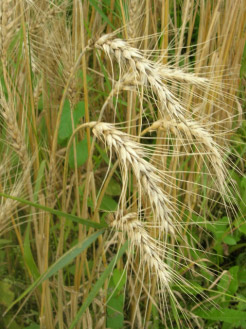
Biodynamically produced cereals are grown under the most harmonious conditions without using herbicides, insecticides, pesticides or fungicides. All the consumer receives is clean, vibrantly alive Aszita wheat berries. These can be flaked, sprouted, cooked, or milled into flour. The freshly milled flour contains all the nutrients, enzymes and other ingredients required. No additives are needed.
I asked the following people connected with the grain share initiative of the Biodynamic Association of Ireland to explain what it means to them and I also include my views as Grain Share Co-ordinator:
- Ernest Mackey – organic farmer who grows the Aszita baking wheat
- Jean Mackey – farmers wife who cares for the farm, the family and BD course participants
- Lionel Mackey, son of Jean and Ernest who manages part of the farm
- Mattheus Wagter, chairman of the Biodynamic Association and eco therapist
Ernest Mackey
Well, I am farmer and I have a certified organic farm. I’ve been using organic and biodynamic methods since 1997. It works very well for me in terms of crop health and yield. The absence of herbicides and pesticides gives me a reassuring feeling for myself, my family and my animals. But also I feel happy to sell my produce knowing there are no harmful traces in any of it.
I started with grain share when Michael Miklis spoke to me about his idea of growing grain and sharing with end users. It immediately made sense to me and I offered to grow the grain. The land here is ideal for growing cereal. We’ve been cultivating winter wheat since 1980 (also some oats, but that’s mostly for ourselves on the farm). Grain share is still a pilot project. It’s now in its third year, constantly evolving and getting better. I like our farm being a hub of learning for those interested in biodynamic practice. And it gives all of us such a sense of confidence and trust in the land we farm.
Jean Mackey
I’ve been interested in biodynamic growing for a long time. We cultivate all the vegetables for our family on our own farm. We don’t sell the produce but friends often get loaded with goodies to bring home. I can mill the grain with a Hawo mill I bought last year and it’s great. Freshly milled flour is the ‘bees knees’. Everybody loves the bread I make – it’s a simple soda bread, Ernest’s mother’s recipe. We’ve used it for years. For myself I make Essene bread. I sprout the grain, then blitz it in the blender, mix it with honey and salt, leave it to rise beside the Aga and when it’s ready it’s baked in a slow oven – soft delicious bread and easy to digest. It’s an ancient recipe and always works well. Having biodynamic workshops on the farm means lots of enjoyment. I prepare some of the meals, and everybody who comes brings a contribution towards the meal, which is fantastic. The kitchen table gets crowded. If it’s good weather we all eat outside. It’s great fun; we love having people come and join in. Often our family members come too and meet everyone. That’s important. We then become one large extended family – as it should be, a farm reaching out to a wider community.
Lionel Mackey
Well, it’s something my Dad does and has done for a long time. Part of the farm has been passed over to me last year and this year I am becoming more involved in the cultivation of the grain. I feel excited about this because it means a whole new field of expertise. I am eager to learn more. I’ve always known about biodynamic practice but now I am ready to become more involved. Grain share means lovely bread my Mom bakes for us all. It’s really quite incredible that we grow the grain and eat the bread. It gives all of us such a sense of confidence and trust in the land we farm.
Nelleke McGrath
Grain share for me is an exciting volunteering effort. I started quite green, knowing very little and I learned as I went along. I’m blessed with people having confidence in me to do the volunteering work. I’ve learned lots about biodynamic practice, growing grain, grain itself and baking bread. Also I’ve a better understanding of the farmer’s concerns and worries. But mostly it’s all roses and optimism. Having fresh grain myself, I’ve become aware of the difference in flavour. I’ve always baked yeast or soda bread but since getting to know this wheat I’ve learned to make bread using water, honey and salt only. This makes a mild sour dough bread, slowly fermented over two days. I add a small amount of caraway seed for extra flavour. We all like this bread, it’s good with sweet and savoury toppings. I’ve also started to experiment with Sekowa backferment.
My work for grain share comprises administration of the shares, keeping share holders up to date and helping with biodynamic workshops.
Recently, I started giving talks to community groups on cereals, growing grain, milling grain and baking bread. It’s called ‘bread for the journey’ and that is what this marvelous grain truly provides bread for the journey of life.
Mattheus Wagter
I have been a biodynamic farmer since I was nineteen when, after my father died, I had to take over the farm. I started organic and then converted to biodynamic, a natural, logical progression in my opinion. I learned to be flexible, strong, determined and use my intuition a lot. The latter led me to become an eco therapist.
Eco therapy is a specialised form of sensing the land and actively helping to improve conditions. It’s a very new field of bringing together various disciplines to harmonise the farm and improve conditions on all levels. The whole farm is involved here: humans, animals, crops, house, land. In the eco therapy process there is a beginning, a middle and an end. So it’s not something that drags on and on. Usually, after the eco-therapy harmonising project is completed I’m asked back for occasional updating consultations. I like to keep in touch with former clients and I like to see how things improve. It’s a bit like helping to start an engine and once it’s running it keeps ticking over nicely. An occasional fine tune is needed but, on the whole, the farms are running fine. I like helping people and doing myself out of a job at the end of it. I like people learning and then knowing how to maintain their own healthy balance.
Grain share is an important part of the work of the Biodynamic Association for promotion of practical biodynamic application and demonstration. I became chair of the biodynamic association of Ireland in 2010.
Grain share brings members of the association together – we assist each other spraying biodynamic preparations. We make preparations. We harvest, clean and bag the grain. We all network to promote and distribute the grain. It’s a joyous fact that we can cultivate good quality wheat in Ireland.
In a wider context, as the Biodynamic Association, we want to increase awareness around this staple food. It’s a basic food and also a complete source of nourishment. ‘Complete’ means that you can live off this whole grain and need very little else. It has all the nutrients the body needs to survive. Regularly we put on bread baking courses to give enthusiastic demonstrations of how well this wheat performs in a variety of baking methods – for instance back-ferment, sour dough, yeast. And the wholemeal flour is also excellent for sweet pastries. This grain is grown with natural vegetation as companions.
Biodynamic sprays are applied at appropriate times to enhance the vitality of the growing crop. What we harvest is truly vibrantly alive grain – excellent for human consumption. The Grain Share Initiative invites interested consumers to invest in next year’s harvest. One share equals one hundred kilos of grain – an estimated average cereal supply for an adult for one year.
Into the West
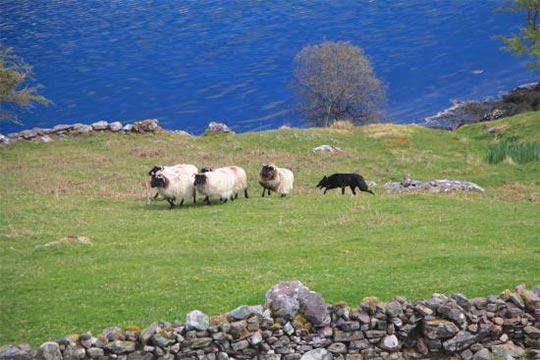
Cáit Curran talks to sheep farmers James and Catherine O'Neill, who are fighting to establish a regional brand for their mountain sheep.
It’s an indication of Ireland’s lack of food culture that one of the country’s finest organic food products has no established market and producers find it difficult to source an organic outlet. That is why James O’Neill has made it his mission to reinstate mountain sheep on the menu and return good old fashioned mutton to its rightful place in the vernacular food language.
Subsistence Farming
Farming 340 ha of mountain land overlooking Killary Harbour near the village of Leenane in Connemara, the stunning landscape provides grazing for his four hundred black-faced mountain sheep. While this might seem like a lot of land and sheep, it is a struggle to eke out a living from the farm. “You can divide that by ten to compare with an average low-land farm,” James says. “Our stocking rate is very low and until we have an established market, some form of state support is needed”.
The O’Neill family - James, his wife Catherine and daughter Aoife love their surroundings and the farming life. “I did the Green Cert in the mid-80s when it was first introduced and I’ve always been involved in agriculture-related work,” he says, while Catherine found it hard at first to adjust to the rural life when she moved out from Galway city. Their isolated location can be a disadvantage in some respects and the O’Neills and a neighbour had sheep stolen last year when they were absent from the farm for a day.
Distinctive Breed
Black-faced, horned mountain sheep are a distinct breed known for their hardiness and ability to withstand cold harsh winters. They survive well on the mountain, making them as close to a wild domesticated animal as you can get. James is convinced that the herbage the mountain pasture provides gives the sheep meat a unique flavour. “We have different types of heather such as ling and cross leaf, purple moor grass, cripple grass and other varieties and this gives a strong flavour to the mutton,” he says. It was the purity of his product that encouraged him to look for organic certification. “There was little difference between how I farmed previously and now, so moving into the organic system wasn’t difficult”.
His sheep are rounded up about four times a year and if liver fluke presents a problem in a wet year, an additional dose may be needed on veterinary certification. “We don’t have quantity but we do have quality,” James says. “We don’t want to go the route of putting up sheds and feeding to finish stock because that dilutes the flavour of the finished animal,” Catherine agrees – “I love mutton. It makes the most tasty stew and our friends are always asking for it. James cooked burgers for the Leenane autumn festival last year and they went like hot cakes”.
Marketing Dilemma
Maintaining the distinctiveness of the product presents the biggest problem. “Conventional lamb is fattened and sold after a few months and because such a good marketing job has been done, people associate spring with the time to try new season’s lamb,” James explains. “We lamb in April and May and it takes eighteen to twenty-four months to finish an animal so we have a limited season usually between August and the end of the year to sell our product. At that stage it is mutton rather than lamb and has had time to develop its exceptional flavour”.
At present, most of James’ lambs are sold as stores through the conventional mart, and while prices have improved somewhat, the real price premium is being reaped by the finisher. In order to create a sustainable business James knows he must bring his stock to finish to get the full premium.
“Is it sustainable to keep an animal for eighteen months and still get a premium,” he asks. “Added to that, can I produce sufficient numbers to consistently supply the market”? What he can sell is curtailed by the need to keep breeding and replacement stock. This could be solved by co-operation among local farmers to increase the numbers of finished sheep available.
“If I could lease more land and make an arrangement with other local farmers so that we could say exactly how many finished sheep we could produce a week, then I would be on the way to making it add up,” James says. At present he is co-operating with another local organic producer and is hoping to persuade a few more to convert.
Local Specialisation
Ideally, he would like to see the product sold locally in restaurants and as a speciality of the region. “We would need our own on-farm processing facility and to keep it within the region as much as possible so that it’s seen as a food local to the Connemara area in the same way that you see local specialities in other European countries”.
Given that food and farming are among the few growth areas in the economy, James thinks it ironic that so little support is available to develop food products. “Leader funding for food is suspended and you would really need some form of support to develop a product like Connemara mutton,” he says. Given the demand for Irish mountain lamb in Europe, James sees no reason why an export market couldn’t be developed in time. “Consistency of supply is the big problem and enabling farmers to grow that supply is the crucial issue”.
Farming Lifestyle
Like all farmers, James is weary of the ever-increasing bureaucracy and regulation associated with farming. “A more sympathetic view of farming in mountainous regions is needed instead of a coverall policy designed with typical lowland farming in mind. The stocking rate of the area must be taken into account,” he feels. “The farmer should be allowed to farm and should be responsible for the land and allowed the freedom to farm but he should also pay the penalty if he contravenes regulations”.
“What we do isn’t for everyone, it’s a way of life,” Catherine says. “I suppose you could say we are trying to survive in Connemara. I’d like to think that our daughter would be able to inherit a sustainable working farm. What we produce is to as high a standard as you will find anywhere in Europe. It is a struggle and it is stressful but we believe in our product and we
Mad as a March Hare
Barbara Buckley gives an insight into the spring antics of the Giorria – the Irish Hare.
With the turn of the year behind us, followed by a mild January, the wildlife around us is showing signs of spring activity. Although hares are basically nocturnal animals they increase their daytime activity in spring and summer time. Their frolics bring to mind what the Cheshire cat said to Alice when she entered into Wonderland: “In that direction lives a Hatter and in that direction lives a March Hare. Visit either you like; they’re both mad”. The ‘boxing matches’ of hares occur between females and males during their frenetic courtship activity. The female tries to fend off the ardent approaches of the male by ‘boxing’ with her front paws. In fact, it has been suggested that the female is also testing the prowess of the male, checking for the best suitor to sire her litters. This eventually leads to a good chase before they mate or don’t! Females have also been seen kicking out backwards at any sly male creeping up from behind. All he gets for his cuteness is a good kick in the gut!
Hares generally rear three litters a year between February and August. Unlike rabbits, they live above ground in sheltered hollows called forms. After a gestation period of forty-seven to fifty-five days, they give birth to two to four leverets born with open eyes. The parents leave their young in the form and as they mature they may move them to other shelter spots closer to their food source. A point of caution here: if you come across two or three healthy leverets crouching under a hedgerow or clump of grass, leave them alone. Their mother is probably close by. An adult, when raised from its hiding spot ‘hares’ off at alarming speed startling many a pensive hill walker.
Hares and Irish Mythology
Hares have long been associated with Celtic myths and folklore. In fact, the ancient Celts believed the hare represented fertility and growth. It was much later in Christian times that the rabbit replaced the hare as the ‘Easter Bunny’. Presumably the rounder fluffier features of the rabbit were more appealing than the quizzical imperious stare of a hare! In one tale, the warrior, Oisin, while hunting wounded a hare in its leg. It escaped and went into a hole in the ground where Oisin followed it. There he found a beautiful young girl attending to a wound in her leg. Other cultures also feature hares. The Buddhists speak of the image of ‘the hare in the moon’ not the man in the moon.
Identifying Features
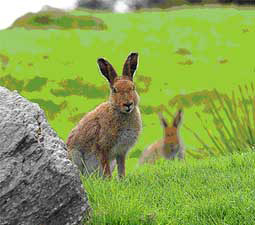
The endemic Irish hare measures between forty-five and sixty-five centimetres and weighs about two to four kilos. As in all mountain hares, the female is generally bigger and heavier than the male. Its characteristic long ears are tipped with black and its ‘scutt’ or tail is greyish white. Its summer coat is generally a more russet brown than its buff brown, sometimes black Scottish relative. Another difference between them is that the Scottish hare develops a white winter coat – to help it blend in with the surrounding snow and the bleached mountain rocks in its habitat. Following our long hard winter last year, many Irish wildlifers were on the lookout to see if the harsh icy conditions led to an increase in whitened hares. Michael Viney, in March 2011, described his first winter white hares although he noted their whitening was not complete. Almost one hundred sightings were recorded in 2011 and are listed on >www.irishhare.org.
Habitat
Mountain hares generally live in mountainous regions across northern Europe. In Ireland, our hares not only live on hillsides and bogs but are also seen on sand dunes, low lands and rich agricultural farmlands, airports and golf courses and have even been observed in one of the long-term car parks beside Dublin airport. The hares of the North Bull in Dublin are a familiar sight to all who use this amenity. It is believed their distribution in the lowlands and farmlands is due to lack of competition between it and the European Brown hare – a scarce resident of a few northern counties. As a result, our hare has developed an appetite for grasses rather than scrubby heather, twigs and tree bark.
Threats/Pressures
Although the Irish hare is classified in the ‘Least Concern’ category in the IUCN Red List of Threatened species, the National Parks and Wildlife Service has worked on its numbers here. In 2006 they found an overall mean density of 3.33 hares / km2. In 2007 that number was raised to 7.66 hares / km2. It appears our Irish hare populations are capable of large and rapid fluctuations, and they cite one instance of farmland in Wexford where over ten years (1995 – 2005), densities ranged between 11.1and 50.5 hares /km2. However they believe that changes in agricultural practices from pastoral to intense systems affect their numbers.
What to look out for this spring
- Squirrel pox in red squirrels: 3rd case recently discovered in south Co. Dublin. Symptoms are like myxomatosis – pus infected eyes are most noticeable. Report to natureconservation@environ.ie
- Tree sparrows: similar to house sparrows but have a rich chestnut brown head with a distinct black spot on each cheek. Numbers are increasing here. Report to info@birdwatchireland.ie
- The first flowers on hazel: The intense carmine red of these tiny flowers will brighten your day.
The Cream of Kildare
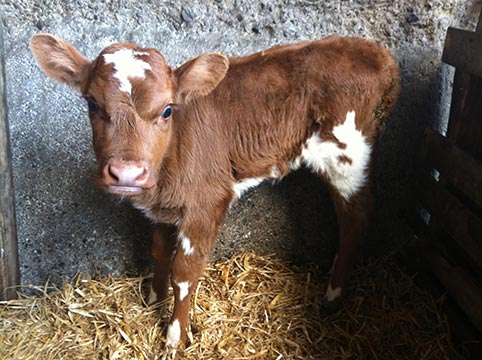
Grace Maher visits Ballymore Farm, a dairy producer making waves with its range of organic products.
Aidan Harney has been milking cows for the past twentyfive years. Growing up on a farm in luscious surroundings in Ballymore Eustace, Co Kildare, this was just part of his daily farming routine. He started farming full time in 1999, but after about four years he was unconvinced about conventional farming, “I felt that I was simply producing a commodity product for the market place. I was using expensive fertilisers, which was not sustainable environmentally or economically. As a small farmer I felt that I had no control over the market price, I felt that I could not be competitive unless I was milking 250 cows and if I did scale up to that level I would be completely unsustainable”. In 2008 Aidan converted the farm to organic production. It was a leap of faith that transformed his farm and he is now a dairy processor as well as a dairy farmer.
“Organic farming was a natural progression for us, my wife Mary owned a health food shop and we ate all organic food, so converting the farm was almost inevitable,” said Aidan. He dropped his stocking rates and his milk output and had the same turnover as when he was a conventional producer.
Organic Dairy Products
Ballymore Farm began to explore the idea of on farm processing at a more commercial level. For many years they had been making butter and yoghurt at a kitchen level. They began to test the waters and started to look at bringing the product to market. “I felt ready to step outside of my comfort zone as a primary producer and add value to my milk product,” Aidan says. “I knew that we were producing a fantastic raw material and we saw a gap in the market for high end dairy products”. At the same time, Kelly’s from Moonshine Organic Farm were selling twenty cows and these were bought by Ian Patterson, a neighbour of Aidans, who has also converted to organic farming and works closely with Ballymore Farm. Aidan and Mary took the opportunity to scale up production and started taking their products to the market. They got a fantastic response and quickly realised that their products had great potential, especially their milk and butter.
“Many people ask us if our butter is like people made long ago but ours is a very different product,” said Aidan. At Ballymore Farm they use sweet cream which is immediately separated after milking using a small electric cream separator. It is churned within twenty-four hours of separation in a small churn and then it is kneaded and washed by hand to wash out the buttermilk. “The milk for traditional farmhouse butter is collected daily for seven days, churned and allowed to ferment which gives it a strong ripe taste. Our butter does not have that strong taste; instead it has a richness and texture which is unique. It is extremely labour intensive and can only be produced in small quantities. We call it our single estate butter, coming from a pool of forty-five cows,” laughed Aidan. “It is a quality premium product and at the moment we cannot keep up with the demand from customers”. Ballymore Farm is the only producer of raw milk butter in Ireland.
Product Range
The products that Ballymore Farm produces are beautifully packaged and include whole milk, butter milk, raw unpasteurised milk and yoghurt. The certified organic products are available at the local Naas farmers market, Glasnevin’s Honest to Goodness market and over fifteen speciality shops in Dublin. They also supply Brooklodge in Wicklow, an organically certified restaurant. The packaging is simple yet eye-catching, and the glass bottles have a nostalgic appeal but are extremely practical. “We offer refills at a discounted price and we take back the bottles from all of our retailers which customers like,” Aidan explains. Ballymore Farm formally launched their products on the market in early April and to date sales have exceeded all of their projections and expectations.
Raw Milk
When promoted about the current raw milk debate, Aidan thinks it is a straightforward issue and production must be regulated to ensure quality is maintained. “We are supplying a product that consumers want, we do not actively push it but people come to us looking for it. At the moment it constitutes 10% of our milk sales. If the product is banned then it helps neither producer nor consumer; regulation is the easy answer. I feel that consumers should have a choice between purchasing a raw or pasteurised product”.
The Future
Ballymore Farm is in its infancy, production-wise. “We need to get noticed, shops don’t know who we are. For now we are content to learn the business, production, processing and marketing. We need to figure out how the system works and how we fit into that system. It has been a steep learning curve. We now employ two people and we are looking to expand further. Mary and I soon realised that this business was bigger than the two of us and we decided to take on a business partner, Joey Burke, and she has been fantastic. She has great energy and valuable inputs. We like the idea of working with partners like Joey and Ian as it gives us more options,” said Aidan. Ballymore Farm is currently experimenting with smoked salted butter, cheese and other dairy products. At the moment they are milking seventy cows but wish to increase this number.
On a personal level it is a huge transition for Aidan: “I am a farmer who now farms on his days off,” he laughs. “However I love what I am doing, it is the reason that I get up in the morning. The satisfaction from talking to customers who love our products is immense. For years I milked cows and now I feel that I am truly completing the chain from farm gate to kitchen table; it is fantastic”. With a growing range of top quality products in huge demand, (including selling out at the recent Irish Food Show in Selfridges!), Ballymore Farm is a name to watch out for and with such commitment and enthusiasm displayed by Aidan, Mary and Joey, it is a company bound for success.
Naturally beautiful
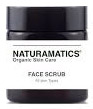
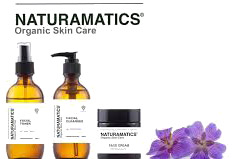
Susan Kelly explains why she is committed to producing organically certified beauty products.
Susan Kelly was blending oils and formulating natural skin products since her teenage years so she never had doubts as to where her eventual career would lead. Now her company, Naturamatics, is a leader in Irish organic skin care products.
A qualified aromatherapist and beauty specialist, Susan studied Naturopathy ten years ago in London, and now works with her products as an Aromatherapist and Beautician in various beauty salons in Dublin. “I was always interested in formulating natural face and body products so I guess you can say that it was a lifelong ambition to produce skin care products. I noticed after returning to Dublin from living in London for ten years and then Australia for two years, the lack of quality, and more importantly, certified organic skin care products sold here in Ireland,” she says.
False Advertising
Organic certification is vitally important for Susan and she has issues with products sold as organic that do not meet organic standards. “There are skin care products that the majority of health food stores in Ireland are claiming to be organic and biodynamic (because the sales rep told them), and they are perhaps natural, and that’s it. My motto is a simple one - if you’re claiming to be organic, you should be certified organic. It costs a whole lot more to buy in certified, but you get your cult following of customers who really investigate their food/skin care, and are faithful and full of good word of mouth about a quality organic brand, so it pays off in the end”.
Susan points out that “the crops used to produce raw materials for skin care, are different to food crops. These natural ingredients can be sprayed with whatever is needed to grow them the quickest, perhaps cultivated too soon and the quality may be very much substandard. When clever marketing follows with a ‘big natural brand’, you get the famous claims of: ‘contains jojoba’, ‘made with pure ingredients’, ‘organic and natural’, etc. To be certified is different ballgame, and if a brand is claiming to be, and they are quite big, then why no certification? We are a micro enterprise, and yet we can. The message is simple: mass scale production will always have clever marketing, and a lot of people who will be in search of an answer to their problems, be it with food, medicine, skin care or household products are offered a dream, and very rarely the real deal!”
Good Planning
In frustration at being another fobbed off customer, Susan came up with a business plan in 2009 to manufacture and produce a range of certified organic skin care products. “I didn't have any budget, but managed to secure a loan from the bank, even though I was unemployed at the time. It was mid-recession but they were happy with the business plan and agreed to lend. I approached Fingal Enterprise Board for funding, after the initial set up, and they also part funded some of the expenses, and were very helpful with mentoring for all my business needs,” she says. A back to work scheme provided her with the time to sit down and sort all the legalities, licenses, cosmetic testing, and regulations. “This was very important to me, as I didn't want to run off with my fanciful ideas, and be stuck financially later down the line, with loose ends that could spell the end for the business, plus I'm a Virgo, so I am a stickler for perfection!” Susan says.
High Quality
Susan wanted the products to be the purest on the market, using selected cold pressed oils for different skin types, virgin vegetable waxes and unrefined nut butters. “These precious oils and waxes, cultivated organically, have all their vitamins and qualities intact, which means that I can make ‘real marketing claims’, considering the quantities in each product, and the benefits of those particular raw materials in their purest state”. She continues “I am an Aromatherapist and like to incorporate essential oils into every skin care, body care and household cleaners that I use. The basis for Naturamatics is aromatherapy essential oils in quantitative amounts in each product, and the highest quality oils and waxes that really benefit the mind, body and soul. The concentrated oils go deep into the skin whilst the essential oils work on harmonizing and balancing the skin. They are also absorbed into the blood stream, where you also receive the benefits within the body. I carefully blend these oils to suit mood, skin type and problem, and they have either uplifting or relaxing qualities”.
On-Line Marketing
Having started with an enthusiastic twenty-five products, Susan is now producing fourteen. These include a range of face creams and oils for different skin types, lip balm, body treatment oils, night balm, dry skin balm, face wash, cleansing oil and toner.
She finds the response from retail stores in relation to Irish and organic products disappointing. “There are just a few die-hard businesses who support organic in Ireland like Healthfoods, Brooklodge Organic Hotel, Dublin Food Co-op. This has pushed me to social media and online directly to customers, which is proving positive, although still slow. The key is education. People do not understand the dangers of skin care products, toothpastes, household cleaners, deodarants, etc, and how toxic they are to our health. The problem is that they build up over time in our blood streams, lymph glands etc, and may at any time cause damage and illnesses that may not be even recognized.
Susan advises “Choose certified organic, natural household cleaners, and certified organic toothpastes. If it is not possible to find organic in Ireland, then there are plenty of UK, or European Brands that can be bought online, or through your local health food store. And remember to always ask your health food store to stock more organic and Irish brands!”
Organic News
Farm Walks 2012
Teagasc and the Department of Agriculture have announced the list of organic farm walks for 2012. The list is perse featuring several farming enterprises but focusing particularly on beef and cereal production on the farms of Paddy Tobin, Johnstown, Co. Kilkenny, Gerry Fitzsimons, Kilcogy, Co. Cavan, Mark Duffy, Ballybay, Co. Monaghan, Kay O’Sullivan, Mallow, Co. Cork, John McLoughlin, Trim, Co. Meath, Pat Lalor, Kilbeggan, Co. Westmeath, Oliver Dixon, Claremorris, Co. Mayo; Alan Mooney, Kilcock, Co. Kildare and Patrick O’Connor, Macroom, Co. Cork.
A walk at Thomas Kinsella’s farm in Gorey, Co. Wexford will focus on sheep and cereals and horticultural holdings featured include Liam Ryan, Athy, Co. Kildare; John and Sarah Devoy, Roscarbery, Co. Cork; Mayo Abbey Organic Centre, Claremorris, Co. Mayo and Gerard and Sylvia Langan, Headford, Co. Galway. Also included is a farm walk at the Crowe farm near Dundrum, Co. Tipperary where pig, turkey and beef production will be presented along with on-farm processing. Sean Condon’s farm at Crecora, Co. Limerick will be the dairy demonstration farm.
Comments (2)
farm walks
2 Friday, 08 June 2012 18:01
Patrick O'Neill
Hi,
I would appreciate if you could inform me of the next farm walks in the Mayo, Galway area. Also could you me tell me wher I can find more information on organic farming in The Mayo, Galway area.
thank you,
Patrick ONeill
farm walks
1 Friday, 08 June 2012 18:00
Patrick O'Neill
Hi,
I would appreciate if you could inform me of the next farm walks in the Mayo, Galway area. Also could you me tell me wher I can find more information on organic farming in The Mayo, Galway area.
thank you,
Patrick ONeill
CSA A Winner
A Soil Association report in the UK finds that Community Supported Agriculture (CSA) offers many benefits to members, communities, local economies and the environment. The report - The Impact of Community Supported Agriculture - states that CSA schemes have at least 5,000 members and feed about 12,500 people every year.
CSA scheme community farms help enable communities to take control of their food supply by providing their members with a variety of local, often organically produced food from vegetables and meat, to milk, bread and honey. In fact, two thirds of members are supplied with all, or nearly all, of their vegetable needs through the community farms. In addition the report shows that CSA schemes deliver many other benefits. Bonnie Hewson, CSA Project Manager at the Soil Association, said "this evaluation report confirms that CSA is powerful on many levels. It is a proactive response to concerns around resilience and transparency in the food system and provides a logical step for consumers towards reclaiming sovereignty over the way their food is grown, processed and traded."
As well as adding to food security, members report feeling significantly happier, with over 70% saying their quality of life has improved with the main proportion saying their cooking and eating habits have changed through using more local, season and healthy food. CSA schemes also contribute to local employment showing high levels of employment relative to the land available (equivalent to 0.14 employees/hectare compared with a mean of 0.027 employees/hectare across UK agriculture as a whole). Another major benefit is the security given to farmers enabling them to plan crops and diversify to meet the needs of members.
Carnahalla Award
IOFGA symbol holders Tom and Johanne Coffey of Carnahalla near Cappawhite in Co. Tipperary were the runners up in two categories at the recent LAMA (Local Authority Members Association) awards. First held in 2006, the LAMA Awards were created to recognise innovative local and national projects in the areas of infrastructure, community development, recreation and social impact initiatives.
The Coffeys were nominated in the best heritage project and the best public building categories and were presented with certificates at the awards ceremony.
Since building an interpretative centre and opening the farm to the public, Carnahalla continues to receive a stream of interested visitors each year. The next guided two-mile tour at Carnahalla will be starting at 2.30pm on Sunday 6th of May.
Organic Matters Magazine is one of Ireland’s top organic farming magazines published by IOA. Organic Matters Magazine is full of information and articles related to organic farming and the organic food market. The magazine is complimentary to IOA members.
This was the magazine's official website for a number of years. If you would like to be featured in the magazine please contact grace.maher@iofga.org.go to: www.irishorganicassociation.ie/about/organic-matters-magazine/
If you have inadvertently ended up here why searching for Organic Matters the new owners of this domain encourage you to go to the Irish Organic Association's website at: www.irishorganicassociation.ie/
Content is from the site's 2011 - 2012 archived pages., as well as other outside sources providing a glimpse of the type of information this magazine offers its readership.
About Organic Matters
If Organic matters to you then you've come to the right place. Whether you're an organic farmer or gardener, or just have an interest in the environment and the benefits of organic food, you'll find the information you're looking for.
Organic Matters features articles on organic farming, gardening tips, organic recipes, environmentalism and consumer issues and lots more, many of which can be read in our features section.
Organicmattersmag.com
As well as features from the magazine, our site contains exclusive articles and advice not featured in the magazine or anywhere else such as the series 'What do organic gardeners do about?' and 'Gardening Tips'.
We welcome news, comments and articles for inclusion in the magazine or on the website. Contact us if you wish to submit an item, or have any queries regarding the magazine or this website.
About the magazine
Organic Matters is published quarterly by the Irish Organic Farmers and Growers Association (IOFGA). Each issue is available through Easons and WNS distribution, from many wholefood shops and market stalls around the country, and by subscription.
Organic Matters is edited by Cáit Curran.
FEATURES
A Family Affair
The Crowe brothers run a variety of enterprises from their family farm near Dundrum in Co. Tipperary. John Paul Crowe talks turkey with Cáit Curran
Hobbling about on crutches is no fun when you have to look after six hundred turkeys, so it’s lucky for John Paul Crowe that he has family help at this crucial time of year for a poultry enterprise. A recent broken ankle has slowed him down but he expects to be fully back in harness before the onset of the main Christmas rush.
Diversifying
The resourceful Crowe brothers have developed their Tipperary-based business since converting to organic in 2006, adding pigs, turkeys and occasionally sheep to their existing beef enterprise. TJ looks after the family abattoir and butchery while Eamonn takes care of transport and delivery and John Paul is responsible for the turkeys. “It’s our third year to have turkeys,” he explains. “We started out with two hundred and increased that to four hundred last year. I thought we could have sold at least another fifty last year so I decided to increase the number again this year. I’m confident that we will have a market for all six hundred”.
Even though he reared some white turkeys to begin with, John Paul has opted for all bronze varieties this year. “They are better overall, hardier and easier to manage and have a better flavour,” he says. There is demand for all sizes of turkey so he buys in a variety of breeds as day-old chicks to ensure a range of sizes for the Christmas market. “This year I got the chicks on 22nd June which is earlier than last year, but bronze turkeys need the time to grow and develop flavour. They are much slower than white turkeys”.
The first six weeks is the tricky period when fatalities are most likely to occur. “There is a lot to learn in the first few weeks. The chicks remain on heat for six weeks and are weaned off by week seven,” says John Paul. “Then they are moved to the grower house and have full access to outdoors. They are fed an organic turkey starter for the first period and that is followed by a grower ration until twelve weeks. Then they go on to a mix of wheat, barley, oats and a rapeseed by-product”.
Turkey Plucking
Bronze turkeys are very healthy and adapt to the outdoors quickly. “Starting that bit earlier this year was an advantage and the birds have a lovely healthy sheen on their feathers at the moment,” he says. “They are out in all weathers but good shelter and good fencing are essential”. To prove the point, thirty birds decamped to the neighbours and were missing for three days until spotted in a neighbouring field.
Killing for the Christmas market starts around the 12th December and these birds will be dry plucked and hung for a couple of weeks. The remainder will be killed on 21st December, wet plucked and stored in a cold room awaiting collection and distribution. “We supply some butchers, we have a lot of on line orders and some birds are delivered by courier,” says John Paul. “We distribute to Limerick, Cork, Dublin and Waterford. In the run up to Christmas, a lot of customers will call to pick up birds from the farm”.
The Crowes supply around 3,000 hams at Christmas and John Paul finds that the turkeys fit well with their market. They keep ten sows and finish about forty organic pigs for Christmas. “There is good demand for organic pork especially from restaurants.
Overall, the demand is good and orders are not down this year. People never stint on Christmas. It’s one time of year free from recession”. John Paul keeps his organic pork prices in line with free range price levels and finds the demand growing year on year.
The level of organic or even free range pork production is tiny in Ireland compared to the UK where 60% of product is a combination of organic and free range. He feels that there is huge potential for development and a production standard is currently being drafted by Bord Bia. He sees difficulty with keeping pigs outdoors through the winter and envisages some form of housing with limited access to outdoors. “Pigs thrive outdoors in summer but, in our weather conditions, it is more difficult in winter,” he says.
Future Growth
Another aspect of the Crowes business is also growing in popularity. They invested in a large spit to roast whole pigs for shows, concerts and events. This proved so popular that they now have five machines on the go during peak season.
The abattoir is a major part of the business and they have an organic licence to kill for their own business and for individual farmers. For the future, John Paul sees the family investing in more on-farm facilities. “It makes sense to have a dedicated abattoir for killing turkeys so that we can do all the processing ourselves. As well as that we will need to invest in more equipment and storage”.
With the growing resurgence in self-sufficiency and new small enterprises, the Crowes have added a further string to their bow. “We run a number of courses on sausage making, butchery, smoking and organic pig production,” John Paul says. “We usually run our courses in conjunction with NOTS when there is sufficient demand”.
Going organic is something that he has not regretted. “Since I became an organic farmer I am a better farmer. I’ve learned a lot about rotations, soil and the importance of farmyard manure. I’m farming more efficiently and more effectively. Even though the stocking rate is lower, I don’t have the cost of expensive inputs. I have to plan in advance all the time and providing the best life for your animals will repay you in the end”. He advises anyone starting out to start small and grow with the market. “It’s important to know where you are going and to look at the viability of your business. If you don’t have a market, don’t do it”. He foresees the market for organic will always be there as long as it is a quality product. “You are not just selling a product; you are selling yourself and a way of life as well”.
For now, once the last customer is out the gate on Christmas Eve, John Paul is looking forward to putting his feet up and enjoying the turkey and ham.
The grain share initiative
In an effort to create a strong, direct relationship with Irish consumers and promote an active partnership that improves food security, a group of Irish farmers have set up the Grain Share Initiative. Nelleke McGrath reports.
This initiative encourages the Irish farmer to grow directly for the end-user while securing proven seed for future harvest and supporting a sustainable way of farming.
Biodynamically produced cereals are grown under the most harmonious conditions without using herbicides, insecticides, pesticides or fungicides. All the consumer receives is clean, vibrantly alive Aszita wheat berries. These can be flaked, sprouted, cooked, or milled into flour. The freshly milled flour contains all the nutrients, enzymes and other ingredients required. No additives are needed.
I asked the following people connected with the grain share initiative of the Biodynamic Association of Ireland to explain what it means to them and I also include my views as Grain Share Co-ordinator:
- Ernest Mackey – organic farmer who grows the Aszita baking wheat
- Jean Mackey – farmers wife who cares for the farm, the family and BD course participants
- Lionel Mackey, son of Jean and Ernest who manages part of the farm
- Mattheus Wagter, chairman of the Biodynamic Association and eco therapist
Ernest Mackey
Well, I am farmer and I have a certified organic farm. I’ve been using organic and biodynamic methods since 1997. It works very well for me in terms of crop health and yield. The absence of herbicides and pesticides gives me a reassuring feeling for myself, my family and my animals. But also I feel happy to sell my produce knowing there are no harmful traces in any of it.
I started with grain share when Michael Miklis spoke to me about his idea of growing grain and sharing with end users. It immediately made sense to me and I offered to grow the grain. The land here is ideal for growing cereal. We’ve been cultivating winter wheat since 1980 (also some oats, but that’s mostly for ourselves on the farm). Grain share is still a pilot project. It’s now in its third year, constantly evolving and getting better. I like our farm being a hub of learning for those interested in biodynamic practice. And it gives all of us such a sense of confidence and trust in the land we farm.
Jean Mackey
I’ve been interested in biodynamic growing for a long time. We cultivate all the vegetables for our family on our own farm. We don’t sell the produce but friends often get loaded with goodies to bring home. I can mill the grain with a Hawo mill I bought last year and it’s great. Freshly milled flour is the ‘bees knees’. Everybody loves the bread I make – it’s a simple soda bread, Ernest’s mother’s recipe. We’ve used it for years. For myself I make Essene bread. I sprout the grain, then blitz it in the blender, mix it with honey and salt, leave it to rise beside the Aga and when it’s ready it’s baked in a slow oven – soft delicious bread and easy to digest. It’s an ancient recipe and always works well. Having biodynamic workshops on the farm means lots of enjoyment. I prepare some of the meals, and everybody who comes brings a contribution towards the meal, which is fantastic. The kitchen table gets crowded. If it’s good weather we all eat outside. It’s great fun; we love having people come and join in. Often our family members come too and meet everyone. That’s important. We then become one large extended family – as it should be, a farm reaching out to a wider community.
Lionel Mackey
Well, it’s something my Dad does and has done for a long time. Part of the farm has been passed over to me last year and this year I am becoming more involved in the cultivation of the grain. I feel excited about this because it means a whole new field of expertise. I am eager to learn more. I’ve always known about biodynamic practice but now I am ready to become more involved. Grain share means lovely bread my Mom bakes for us all. It’s really quite incredible that we grow the grain and eat the bread. It gives all of us such a sense of confidence and trust in the land we farm.
Nelleke McGrath
Grain share for me is an exciting volunteering effort. I started quite green, knowing very little and I learned as I went along. I’m blessed with people having confidence in me to do the volunteering work. I’ve learned lots about biodynamic practice, growing grain, grain itself and baking bread. Also I’ve a better understanding of the farmer’s concerns and worries. But mostly it’s all roses and optimism. Having fresh grain myself, I’ve become aware of the difference in flavour. I’ve always baked yeast or soda bread but since getting to know this wheat I’ve learned to make bread using water, honey and salt only. This makes a mild sour dough bread, slowly fermented over two days. I add a small amount of caraway seed for extra flavour. We all like this bread, it’s good with sweet and savoury toppings. I’ve also started to experiment with Sekowa backferment.
My work for grain share comprises administration of the shares, keeping share holders up to date and helping with biodynamic workshops.
Recently, I started giving talks to community groups on cereals, growing grain, milling grain and baking bread. It’s called ‘bread for the journey’ and that is what this marvelous grain truly provides bread for the journey of life.
Mattheus Wagter
I have been a biodynamic farmer since I was nineteen when, after my father died, I had to take over the farm. I started organic and then converted to biodynamic, a natural, logical progression in my opinion. I learned to be flexible, strong, determined and use my intuition a lot. The latter led me to become an eco therapist.
Eco therapy is a specialised form of sensing the land and actively helping to improve conditions. It’s a very new field of bringing together various disciplines to harmonise the farm and improve conditions on all levels. The whole farm is involved here: humans, animals, crops, house, land. In the eco therapy process there is a beginning, a middle and an end. So it’s not something that drags on and on. Usually, after the eco-therapy harmonising project is completed I’m asked back for occasional updating consultations. I like to keep in touch with former clients and I like to see how things improve. It’s a bit like helping to start an engine and once it’s running it keeps ticking over nicely. An occasional fine tune is needed but, on the whole, the farms are running fine. I like helping people and doing myself out of a job at the end of it. I like people learning and then knowing how to maintain their own healthy balance.
Grain share is an important part of the work of the Biodynamic Association for promotion of practical biodynamic application and demonstration. I became chair of the biodynamic association of Ireland in 2010.
Grain share brings members of the association together – we assist each other spraying biodynamic preparations. We make preparations. We harvest, clean and bag the grain. We all network to promote and distribute the grain. It’s a joyous fact that we can cultivate good quality wheat in Ireland.
In a wider context, as the Biodynamic Association, we want to increase awareness around this staple food. It’s a basic food and also a complete source of nourishment. ‘Complete’ means that you can live off this whole grain and need very little else. It has all the nutrients the body needs to survive. Regularly we put on bread baking courses to give enthusiastic demonstrations of how well this wheat performs in a variety of baking methods – for instance back-ferment, sour dough, yeast. And the wholemeal flour is also excellent for sweet pastries. This grain is grown with natural vegetation as companions.
Biodynamic sprays are applied at appropriate times to enhance the vitality of the growing crop. What we harvest is truly vibrantly alive grain – excellent for human consumption. The Grain Share Initiative invites interested consumers to invest in next year’s harvest. One share equals one hundred kilos of grain – an estimated average cereal supply for an adult for one year.
Into the West
Cáit Curran talks to sheep farmers James and Catherine O'Neill, who are fighting to establish a regional brand for their mountain sheep.
It’s an indication of Ireland’s lack of food culture that one of the country’s finest organic food products has no established market and producers find it difficult to source an organic outlet. That is why James O’Neill has made it his mission to reinstate mountain sheep on the menu and return good old fashioned mutton to its rightful place in the vernacular food language.
Subsistence Farming
Farming 340 ha of mountain land overlooking Killary Harbour near the village of Leenane in Connemara, the stunning landscape provides grazing for his four hundred black-faced mountain sheep. While this might seem like a lot of land and sheep, it is a struggle to eke out a living from the farm. “You can divide that by ten to compare with an average low-land farm,” James says. “Our stocking rate is very low and until we have an established market, some form of state support is needed”.
The O’Neill family - James, his wife Catherine and daughter Aoife love their surroundings and the farming life. “I did the Green Cert in the mid-80s when it was first introduced and I’ve always been involved in agriculture-related work,” he says, while Catherine found it hard at first to adjust to the rural life when she moved out from Galway city. Their isolated location can be a disadvantage in some respects and the O’Neills and a neighbour had sheep stolen last year when they were absent from the farm for a day.
Distinctive Breed
Black-faced, horned mountain sheep are a distinct breed known for their hardiness and ability to withstand cold harsh winters. They survive well on the mountain, making them as close to a wild domesticated animal as you can get. James is convinced that the herbage the mountain pasture provides gives the sheep meat a unique flavour. “We have different types of heather such as ling and cross leaf, purple moor grass, cripple grass and other varieties and this gives a strong flavour to the mutton,” he says. It was the purity of his product that encouraged him to look for organic certification. “There was little difference between how I farmed previously and now, so moving into the organic system wasn’t difficult”.
His sheep are rounded up about four times a year and if liver fluke presents a problem in a wet year, an additional dose may be needed on veterinary certification. “We don’t have quantity but we do have quality,” James says. “We don’t want to go the route of putting up sheds and feeding to finish stock because that dilutes the flavour of the finished animal,” Catherine agrees – “I love mutton. It makes the most tasty stew and our friends are always asking for it. James cooked burgers for the Leenane autumn festival last year and they went like hot cakes”.
Marketing Dilemma
Maintaining the distinctiveness of the product presents the biggest problem. “Conventional lamb is fattened and sold after a few months and because such a good marketing job has been done, people associate spring with the time to try new season’s lamb,” James explains. “We lamb in April and May and it takes eighteen to twenty-four months to finish an animal so we have a limited season usually between August and the end of the year to sell our product. At that stage it is mutton rather than lamb and has had time to develop its exceptional flavour”.
At present, most of James’ lambs are sold as stores through the conventional mart, and while prices have improved somewhat, the real price premium is being reaped by the finisher. In order to create a sustainable business James knows he must bring his stock to finish to get the full premium.
“Is it sustainable to keep an animal for eighteen months and still get a premium,” he asks. “Added to that, can I produce sufficient numbers to consistently supply the market”? What he can sell is curtailed by the need to keep breeding and replacement stock. This could be solved by co-operation among local farmers to increase the numbers of finished sheep available.
“If I could lease more land and make an arrangement with other local farmers so that we could say exactly how many finished sheep we could produce a week, then I would be on the way to making it add up,” James says. At present he is co-operating with another local organic producer and is hoping to persuade a few more to convert.
Local Specialisation
Ideally, he would like to see the product sold locally in restaurants and as a speciality of the region. “We would need our own on-farm processing facility and to keep it within the region as much as possible so that it’s seen as a food local to the Connemara area in the same way that you see local specialities in other European countries”.
Given that food and farming are among the few growth areas in the economy, James thinks it ironic that so little support is available to develop food products. “Leader funding for food is suspended and you would really need some form of support to develop a product like Connemara mutton,” he says. Given the demand for Irish mountain lamb in Europe, James sees no reason why an export market couldn’t be developed in time. “Consistency of supply is the big problem and enabling farmers to grow that supply is the crucial issue”.
Farming Lifestyle
Like all farmers, James is weary of the ever-increasing bureaucracy and regulation associated with farming. “A more sympathetic view of farming in mountainous regions is needed instead of a coverall policy designed with typical lowland farming in mind. The stocking rate of the area must be taken into account,” he feels. “The farmer should be allowed to farm and should be responsible for the land and allowed the freedom to farm but he should also pay the penalty if he contravenes regulations”.
“What we do isn’t for everyone, it’s a way of life,” Catherine says. “I suppose you could say we are trying to survive in Connemara. I’d like to think that our daughter would be able to inherit a sustainable working farm. What we produce is to as high a standard as you will find anywhere in Europe. It is a struggle and it is stressful but we believe in our product and we
Mad as a March Hare
Barbara Buckley gives an insight into the spring antics of the Giorria – the Irish Hare.
With the turn of the year behind us, followed by a mild January, the wildlife around us is showing signs of spring activity. Although hares are basically nocturnal animals they increase their daytime activity in spring and summer time. Their frolics bring to mind what the Cheshire cat said to Alice when she entered into Wonderland: “In that direction lives a Hatter and in that direction lives a March Hare. Visit either you like; they’re both mad”. The ‘boxing matches’ of hares occur between females and males during their frenetic courtship activity. The female tries to fend off the ardent approaches of the male by ‘boxing’ with her front paws. In fact, it has been suggested that the female is also testing the prowess of the male, checking for the best suitor to sire her litters. This eventually leads to a good chase before they mate or don’t! Females have also been seen kicking out backwards at any sly male creeping up from behind. All he gets for his cuteness is a good kick in the gut!
Hares generally rear three litters a year between February and August. Unlike rabbits, they live above ground in sheltered hollows called forms. After a gestation period of forty-seven to fifty-five days, they give birth to two to four leverets born with open eyes. The parents leave their young in the form and as they mature they may move them to other shelter spots closer to their food source. A point of caution here: if you come across two or three healthy leverets crouching under a hedgerow or clump of grass, leave them alone. Their mother is probably close by. An adult, when raised from its hiding spot ‘hares’ off at alarming speed startling many a pensive hill walker.
Hares and Irish Mythology
Hares have long been associated with Celtic myths and folklore. In fact, the ancient Celts believed the hare represented fertility and growth. It was much later in Christian times that the rabbit replaced the hare as the ‘Easter Bunny’. Presumably the rounder fluffier features of the rabbit were more appealing than the quizzical imperious stare of a hare! In one tale, the warrior, Oisin, while hunting wounded a hare in its leg. It escaped and went into a hole in the ground where Oisin followed it. There he found a beautiful young girl attending to a wound in her leg. Other cultures also feature hares. The Buddhists speak of the image of ‘the hare in the moon’ not the man in the moon.
Identifying Features
The endemic Irish hare measures between forty-five and sixty-five centimetres and weighs about two to four kilos. As in all mountain hares, the female is generally bigger and heavier than the male. Its characteristic long ears are tipped with black and its ‘scutt’ or tail is greyish white. Its summer coat is generally a more russet brown than its buff brown, sometimes black Scottish relative. Another difference between them is that the Scottish hare develops a white winter coat – to help it blend in with the surrounding snow and the bleached mountain rocks in its habitat. Following our long hard winter last year, many Irish wildlifers were on the lookout to see if the harsh icy conditions led to an increase in whitened hares. Michael Viney, in March 2011, described his first winter white hares although he noted their whitening was not complete. Almost one hundred sightings were recorded in 2011 and are listed on >www.irishhare.org.
Habitat
Mountain hares generally live in mountainous regions across northern Europe. In Ireland, our hares not only live on hillsides and bogs but are also seen on sand dunes, low lands and rich agricultural farmlands, airports and golf courses and have even been observed in one of the long-term car parks beside Dublin airport. The hares of the North Bull in Dublin are a familiar sight to all who use this amenity. It is believed their distribution in the lowlands and farmlands is due to lack of competition between it and the European Brown hare – a scarce resident of a few northern counties. As a result, our hare has developed an appetite for grasses rather than scrubby heather, twigs and tree bark.
Threats/Pressures
Although the Irish hare is classified in the ‘Least Concern’ category in the IUCN Red List of Threatened species, the National Parks and Wildlife Service has worked on its numbers here. In 2006 they found an overall mean density of 3.33 hares / km2. In 2007 that number was raised to 7.66 hares / km2. It appears our Irish hare populations are capable of large and rapid fluctuations, and they cite one instance of farmland in Wexford where over ten years (1995 – 2005), densities ranged between 11.1and 50.5 hares /km2. However they believe that changes in agricultural practices from pastoral to intense systems affect their numbers.
What to look out for this spring
- Squirrel pox in red squirrels: 3rd case recently discovered in south Co. Dublin. Symptoms are like myxomatosis – pus infected eyes are most noticeable. Report to natureconservation@environ.ie
- Tree sparrows: similar to house sparrows but have a rich chestnut brown head with a distinct black spot on each cheek. Numbers are increasing here. Report to info@birdwatchireland.ie
- The first flowers on hazel: The intense carmine red of these tiny flowers will brighten your day.
The Cream of Kildare
Grace Maher visits Ballymore Farm, a dairy producer making waves with its range of organic products.
Aidan Harney has been milking cows for the past twentyfive years. Growing up on a farm in luscious surroundings in Ballymore Eustace, Co Kildare, this was just part of his daily farming routine. He started farming full time in 1999, but after about four years he was unconvinced about conventional farming, “I felt that I was simply producing a commodity product for the market place. I was using expensive fertilisers, which was not sustainable environmentally or economically. As a small farmer I felt that I had no control over the market price, I felt that I could not be competitive unless I was milking 250 cows and if I did scale up to that level I would be completely unsustainable”. In 2008 Aidan converted the farm to organic production. It was a leap of faith that transformed his farm and he is now a dairy processor as well as a dairy farmer.
“Organic farming was a natural progression for us, my wife Mary owned a health food shop and we ate all organic food, so converting the farm was almost inevitable,” said Aidan. He dropped his stocking rates and his milk output and had the same turnover as when he was a conventional producer.
Organic Dairy Products
Ballymore Farm began to explore the idea of on farm processing at a more commercial level. For many years they had been making butter and yoghurt at a kitchen level. They began to test the waters and started to look at bringing the product to market. “I felt ready to step outside of my comfort zone as a primary producer and add value to my milk product,” Aidan says. “I knew that we were producing a fantastic raw material and we saw a gap in the market for high end dairy products”. At the same time, Kelly’s from Moonshine Organic Farm were selling twenty cows and these were bought by Ian Patterson, a neighbour of Aidans, who has also converted to organic farming and works closely with Ballymore Farm. Aidan and Mary took the opportunity to scale up production and started taking their products to the market. They got a fantastic response and quickly realised that their products had great potential, especially their milk and butter.
“Many people ask us if our butter is like people made long ago but ours is a very different product,” said Aidan. At Ballymore Farm they use sweet cream which is immediately separated after milking using a small electric cream separator. It is churned within twenty-four hours of separation in a small churn and then it is kneaded and washed by hand to wash out the buttermilk. “The milk for traditional farmhouse butter is collected daily for seven days, churned and allowed to ferment which gives it a strong ripe taste. Our butter does not have that strong taste; instead it has a richness and texture which is unique. It is extremely labour intensive and can only be produced in small quantities. We call it our single estate butter, coming from a pool of forty-five cows,” laughed Aidan. “It is a quality premium product and at the moment we cannot keep up with the demand from customers”. Ballymore Farm is the only producer of raw milk butter in Ireland.
Product Range
The products that Ballymore Farm produces are beautifully packaged and include whole milk, butter milk, raw unpasteurised milk and yoghurt. The certified organic products are available at the local Naas farmers market, Glasnevin’s Honest to Goodness market and over fifteen speciality shops in Dublin. They also supply Brooklodge in Wicklow, an organically certified restaurant. The packaging is simple yet eye-catching, and the glass bottles have a nostalgic appeal but are extremely practical. “We offer refills at a discounted price and we take back the bottles from all of our retailers which customers like,” Aidan explains. Ballymore Farm formally launched their products on the market in early April and to date sales have exceeded all of their projections and expectations.
Raw Milk
When promoted about the current raw milk debate, Aidan thinks it is a straightforward issue and production must be regulated to ensure quality is maintained. “We are supplying a product that consumers want, we do not actively push it but people come to us looking for it. At the moment it constitutes 10% of our milk sales. If the product is banned then it helps neither producer nor consumer; regulation is the easy answer. I feel that consumers should have a choice between purchasing a raw or pasteurised product”.
The Future
Ballymore Farm is in its infancy, production-wise. “We need to get noticed, shops don’t know who we are. For now we are content to learn the business, production, processing and marketing. We need to figure out how the system works and how we fit into that system. It has been a steep learning curve. We now employ two people and we are looking to expand further. Mary and I soon realised that this business was bigger than the two of us and we decided to take on a business partner, Joey Burke, and she has been fantastic. She has great energy and valuable inputs. We like the idea of working with partners like Joey and Ian as it gives us more options,” said Aidan. Ballymore Farm is currently experimenting with smoked salted butter, cheese and other dairy products. At the moment they are milking seventy cows but wish to increase this number.
On a personal level it is a huge transition for Aidan: “I am a farmer who now farms on his days off,” he laughs. “However I love what I am doing, it is the reason that I get up in the morning. The satisfaction from talking to customers who love our products is immense. For years I milked cows and now I feel that I am truly completing the chain from farm gate to kitchen table; it is fantastic”. With a growing range of top quality products in huge demand, (including selling out at the recent Irish Food Show in Selfridges!), Ballymore Farm is a name to watch out for and with such commitment and enthusiasm displayed by Aidan, Mary and Joey, it is a company bound for success.
Naturally beautiful
Susan Kelly explains why she is committed to producing organically certified beauty products.
Susan Kelly was blending oils and formulating natural skin products since her teenage years so she never had doubts as to where her eventual career would lead. Now her company, Naturamatics, is a leader in Irish organic skin care products.
A qualified aromatherapist and beauty specialist, Susan studied Naturopathy ten years ago in London, and now works with her products as an Aromatherapist and Beautician in various beauty salons in Dublin. “I was always interested in formulating natural face and body products so I guess you can say that it was a lifelong ambition to produce skin care products. I noticed after returning to Dublin from living in London for ten years and then Australia for two years, the lack of quality, and more importantly, certified organic skin care products sold here in Ireland,” she says.
False Advertising
Organic certification is vitally important for Susan and she has issues with products sold as organic that do not meet organic standards. “There are skin care products that the majority of health food stores in Ireland are claiming to be organic and biodynamic (because the sales rep told them), and they are perhaps natural, and that’s it. My motto is a simple one - if you’re claiming to be organic, you should be certified organic. It costs a whole lot more to buy in certified, but you get your cult following of customers who really investigate their food/skin care, and are faithful and full of good word of mouth about a quality organic brand, so it pays off in the end”.
Susan points out that “the crops used to produce raw materials for skin care, are different to food crops. These natural ingredients can be sprayed with whatever is needed to grow them the quickest, perhaps cultivated too soon and the quality may be very much substandard. When clever marketing follows with a ‘big natural brand’, you get the famous claims of: ‘contains jojoba’, ‘made with pure ingredients’, ‘organic and natural’, etc. To be certified is different ballgame, and if a brand is claiming to be, and they are quite big, then why no certification? We are a micro enterprise, and yet we can. The message is simple: mass scale production will always have clever marketing, and a lot of people who will be in search of an answer to their problems, be it with food, medicine, skin care or household products are offered a dream, and very rarely the real deal!”
Good Planning
In frustration at being another fobbed off customer, Susan came up with a business plan in 2009 to manufacture and produce a range of certified organic skin care products. “I didn't have any budget, but managed to secure a loan from the bank, even though I was unemployed at the time. It was mid-recession but they were happy with the business plan and agreed to lend. I approached Fingal Enterprise Board for funding, after the initial set up, and they also part funded some of the expenses, and were very helpful with mentoring for all my business needs,” she says. A back to work scheme provided her with the time to sit down and sort all the legalities, licenses, cosmetic testing, and regulations. “This was very important to me, as I didn't want to run off with my fanciful ideas, and be stuck financially later down the line, with loose ends that could spell the end for the business, plus I'm a Virgo, so I am a stickler for perfection!” Susan says.
High Quality
Susan wanted the products to be the purest on the market, using selected cold pressed oils for different skin types, virgin vegetable waxes and unrefined nut butters. “These precious oils and waxes, cultivated organically, have all their vitamins and qualities intact, which means that I can make ‘real marketing claims’, considering the quantities in each product, and the benefits of those particular raw materials in their purest state”. She continues “I am an Aromatherapist and like to incorporate essential oils into every skin care, body care and household cleaners that I use. The basis for Naturamatics is aromatherapy essential oils in quantitative amounts in each product, and the highest quality oils and waxes that really benefit the mind, body and soul. The concentrated oils go deep into the skin whilst the essential oils work on harmonizing and balancing the skin. They are also absorbed into the blood stream, where you also receive the benefits within the body. I carefully blend these oils to suit mood, skin type and problem, and they have either uplifting or relaxing qualities”.
On-Line Marketing
Having started with an enthusiastic twenty-five products, Susan is now producing fourteen. These include a range of face creams and oils for different skin types, lip balm, body treatment oils, night balm, dry skin balm, face wash, cleansing oil and toner.
She finds the response from retail stores in relation to Irish and organic products disappointing. “There are just a few die-hard businesses who support organic in Ireland like Healthfoods, Brooklodge Organic Hotel, Dublin Food Co-op. This has pushed me to social media and online directly to customers, which is proving positive, although still slow. The key is education. People do not understand the dangers of skin care products, toothpastes, household cleaners, deodarants, etc, and how toxic they are to our health. The problem is that they build up over time in our blood streams, lymph glands etc, and may at any time cause damage and illnesses that may not be even recognized.
Susan advises “Choose certified organic, natural household cleaners, and certified organic toothpastes. If it is not possible to find organic in Ireland, then there are plenty of UK, or European Brands that can be bought online, or through your local health food store. And remember to always ask your health food store to stock more organic and Irish brands!”
Organic News
Farm Walks 2012
Teagasc and the Department of Agriculture have announced the list of organic farm walks for 2012. The list is perse featuring several farming enterprises but focusing particularly on beef and cereal production on the farms of Paddy Tobin, Johnstown, Co. Kilkenny, Gerry Fitzsimons, Kilcogy, Co. Cavan, Mark Duffy, Ballybay, Co. Monaghan, Kay O’Sullivan, Mallow, Co. Cork, John McLoughlin, Trim, Co. Meath, Pat Lalor, Kilbeggan, Co. Westmeath, Oliver Dixon, Claremorris, Co. Mayo; Alan Mooney, Kilcock, Co. Kildare and Patrick O’Connor, Macroom, Co. Cork.
A walk at Thomas Kinsella’s farm in Gorey, Co. Wexford will focus on sheep and cereals and horticultural holdings featured include Liam Ryan, Athy, Co. Kildare; John and Sarah Devoy, Roscarbery, Co. Cork; Mayo Abbey Organic Centre, Claremorris, Co. Mayo and Gerard and Sylvia Langan, Headford, Co. Galway. Also included is a farm walk at the Crowe farm near Dundrum, Co. Tipperary where pig, turkey and beef production will be presented along with on-farm processing. Sean Condon’s farm at Crecora, Co. Limerick will be the dairy demonstration farm.
Comments (2)
farm walks
2 Friday, 08 June 2012 18:01
Patrick O'Neill
Hi,
I would appreciate if you could inform me of the next farm walks in the Mayo, Galway area. Also could you me tell me wher I can find more information on organic farming in The Mayo, Galway area.
thank you,
Patrick ONeill
farm walks
1 Friday, 08 June 2012 18:00
Patrick O'Neill
Hi,
I would appreciate if you could inform me of the next farm walks in the Mayo, Galway area. Also could you me tell me wher I can find more information on organic farming in The Mayo, Galway area.
thank you,
Patrick ONeill
CSA A Winner
A Soil Association report in the UK finds that Community Supported Agriculture (CSA) offers many benefits to members, communities, local economies and the environment. The report - The Impact of Community Supported Agriculture - states that CSA schemes have at least 5,000 members and feed about 12,500 people every year.
CSA scheme community farms help enable communities to take control of their food supply by providing their members with a variety of local, often organically produced food from vegetables and meat, to milk, bread and honey. In fact, two thirds of members are supplied with all, or nearly all, of their vegetable needs through the community farms. In addition the report shows that CSA schemes deliver many other benefits. Bonnie Hewson, CSA Project Manager at the Soil Association, said "this evaluation report confirms that CSA is powerful on many levels. It is a proactive response to concerns around resilience and transparency in the food system and provides a logical step for consumers towards reclaiming sovereignty over the way their food is grown, processed and traded."
As well as adding to food security, members report feeling significantly happier, with over 70% saying their quality of life has improved with the main proportion saying their cooking and eating habits have changed through using more local, season and healthy food. CSA schemes also contribute to local employment showing high levels of employment relative to the land available (equivalent to 0.14 employees/hectare compared with a mean of 0.027 employees/hectare across UK agriculture as a whole). Another major benefit is the security given to farmers enabling them to plan crops and diversify to meet the needs of members.
Carnahalla Award
IOFGA symbol holders Tom and Johanne Coffey of Carnahalla near Cappawhite in Co. Tipperary were the runners up in two categories at the recent LAMA (Local Authority Members Association) awards. First held in 2006, the LAMA Awards were created to recognise innovative local and national projects in the areas of infrastructure, community development, recreation and social impact initiatives.
The Coffeys were nominated in the best heritage project and the best public building categories and were presented with certificates at the awards ceremony.
Since building an interpretative centre and opening the farm to the public, Carnahalla continues to receive a stream of interested visitors each year. The next guided two-mile tour at Carnahalla will be starting at 2.30pm on Sunday 6th of May.